Solar panel repair in Nashville, TN
Solar panel repair in Nashville, TN is mostly not panel repair. Modules outlast almost everything wired to them, so a system not producing is usually an inverter, a connector, a breaker or a tree. The first job is working out which. The second is telling you honestly whether fixing it pays.
Solar modules are the most reliable thing on the roof. They have no moving parts, they carry long performance warranties, and they routinely outlast the electronics wired to them. So when a system stops producing, the panels are rarely the answer, and a page called solar panel repair is mostly about everything else.
Why are people getting rid of their solar panels?
People here ask this more often than they ask what a system costs, and it deserves a straight answer rather than an argument.
Some of it is contractual. A lease or a power purchase agreement puts the equipment on your roof under someone else's ownership, and unwinding one at sale time is genuinely awkward. No repair fixes that.
Some of it is roofing. An asphalt shingle roof reaches the end of its life while the array on top of it is barely middle aged, and a homeowner who is told removal is difficult starts thinking about removing the array for good instead. Taking an array off for roof work and putting it back is an established job with a known sequence.
And some of it is neglect. A fault develops, nobody diagnoses it, the bill drifts back up, and after two or three winters the array reads as a thing that never worked. Nearly all of that third group is repairable, and it is the group this page is written for.
What actually fails on a Middle Tennessee array
In rough order of how often it turns up:
- The inverter. It is the one component doing continuous electrical work in an outdoor enclosure through a Tennessee summer. String inverters generally have a shorter service life than the modules, and inverter replacement is the most common significant repair on an array of any age.
- Microinverters and optimisers. Distributed electronics means a failure usually takes out one panel instead of the system. That is better for production and worse for detection, because nothing obvious happens.
- Connectors and wiring. DC connectors crimped badly at install, or two different connector brands mated together, fail years later once corrosion and heat cycling have done their work.
- Breakers and the AC disconnect. A tripped breaker is the cheapest possible cause of a system not producing, and it is worth ruling out before anything else happens.
- Shade that was not there at install. Middle Tennessee's hardwood canopy grows. An oak that cleared the array in 2018 does not clear it now, and lost production from afternoon shade looks exactly like a hardware fault on a bill.
- Animals. The gap between the modules and the shingles is sheltered, dry and about the right size for a squirrel. Chewed DC wiring is a real repair category here rather than a curiosity.
- The modules. Cracked glass from a limb, a delaminated backsheet, a failed bypass diode. Real, and last on this list for a reason. Panel replacement is a smaller share of this work than the name of the service suggests.
What a month of lost production actually costs here
Almost nobody puts a number on this, and it is the reason a fault in July is a different problem from the same fault in April.
TVA prices residential power seasonally, and NES publishes the pattern: rates are higher in summer, June through September, and in winter, December through March, and lower in the transitional months of April to May and October to November (NES, checked 2026-08-04). The reason NES gives is generation cost, and it is the same reason your array is working hardest in the middle of a hot afternoon.
Put those two together. The array makes the most power in exactly the months when the power it displaces is dearest, so a fault starting in June costs more per lost kilowatt-hour than the same fault starting in October, and it costs it for longer before anyone notices.
The unit figure to hold against that: NES lists a residential base rate of 9.254 cents per kilowatt-hour, effective October 2024, plus a fuel cost adjustment of 2.610 cents per kilowatt-hour for August (NES, checked 2026-08-14). An array quietly making nothing through a Tennessee summer is losing roughly that on every kilowatt-hour it should have made.
That is the argument for diagnosing early rather than adding it to a list. It is also why we will sometimes tell you a fault can safely wait for the autumn transitional months, because sometimes it can.
Diagnosis, in the order it is worth doing
A diagnostic visit works from the cheap end toward the expensive end, and deliberately not the other way round.
- The AC side first. Breaker, disconnect, and the connection at the panel. Nothing on the roof gets touched until the cheap causes are eliminated.
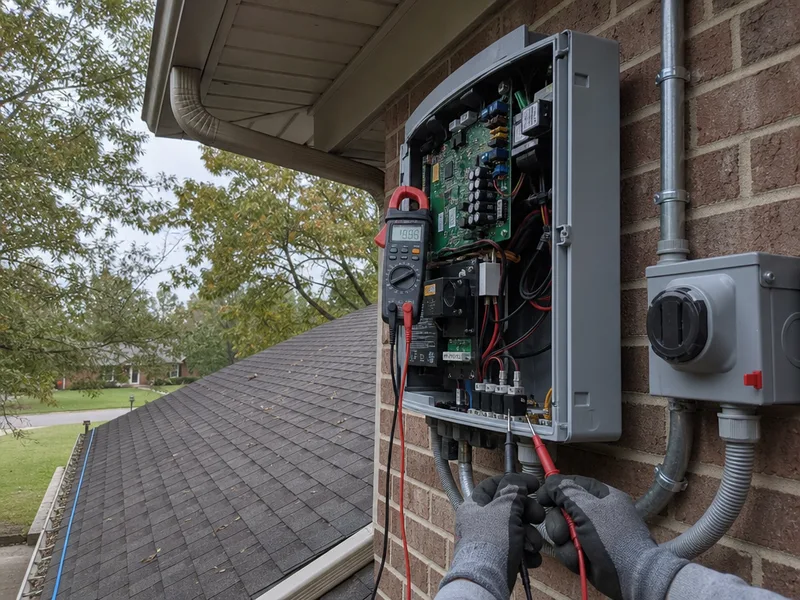
- The inverter. Fault codes, logs where the unit keeps them, and voltage and current at the input against what the array should be delivering in that light.
- The strings. Open circuit voltage and operating current, string by string. This is what locates a dead section rather than a dead system.
- The array surface. Visible damage, connector condition, mounting and flashing, animal activity, and what the trees are now doing after two o'clock.
- The paperwork. Module and inverter warranties, and the original permit if it can be found, because what is still covered changes what should be replaced.
You get told what was found and what the options are, including the option of leaving it alone.
When a repair becomes a utility conversation
A like-for-like replacement is generally the simple case. Changing the electrical configuration or the system size is not, because it touches what your power company already approved.
Both local power companies run their own interconnection and operating agreement, signed when the system was first connected. NES sets out its own paperwork for grid-connected arrays, including that agreement and the rules for its NESolar programmes (NES, checked 2026-08-04), and a system whose capacity changes is no longer the system that agreement describes. Metro Nashville separately treats the work as an Electrical Photovoltaic permit, with a permit that expires six months after issuance if work has not begun (Metro Codes, checked 2026-08-04).
Neither is hard. Both are slow when they are discovered at the end of a job rather than the beginning, which is why the scope you get from us says which one applies.
Repair or replace
At some point the sensible answer stops being repair. The line usually gets drawn by the inverter, because it is both the expensive component and the one that fails.
If the array is young and the inverter has failed once, replacing the inverter is nearly always right. If the array is old, half shaded by trees that have grown since it went up, and the inverter has failed a second time, the real question is whether the roof underneath is also near replacement. In that case the sensible sequence is a roof and a redesigned array rather than another repair.
We will say which of those we think you are looking at. It occasionally costs us the job, and it is the reason to call.
What we need to scope a repair
Send the property address, the inverter make and model, a photograph of the inverter display or its fault light, and a recent power bill. If you still have monitoring access, twelve months of production data tells us more than anything else you could send.
What comes back is a diagnostic scope and a price, with the likely repair paths listed under it, so the range is clear before anyone gets on the roof.
The fuller version of the exit question is in why people get rid of solar panels, and what a working system is worth producing is in solar panel cost in Nashville.
If the answer turns out to be a new system rather than a repair, that is solar installation in Nashville, TN. The rest of what we do is on the solar services hub.
What people ask before booking this
How do I know if my solar panels have stopped working?
Three checks, in order. Look at the inverter itself, because most carry a status light or a small screen and a fault is often visible from the driveway. Look at the monitoring app if the system has one, and compare this month against the same month last year rather than against last month, because production is supposed to fall in December. Then look at your power bill: a system that quietly dropped a string six months ago usually shows up as a bill creeping back toward what you paid before the array went on.
Why are people getting rid of their solar panels?
Three reasons turn up in this market and only one of them is about the panels. Some people are trying to exit a lease or power purchase agreement they signed and did not fully understand. Some need a roof replaced and have been told removal is difficult, which it is not: taking an array off and putting it back is one of the four solar services we cover. And some have a system that stopped producing, never got diagnosed, and turned into a thing on the roof that earns nothing. That third group usually has a repairable fault.
Who repairs solar panels when the company that installed them has closed?
Someone else, and it is a common request here. Solar has a high company turnover rate and a workmanship warranty is only as good as the business behind it. Equipment warranties are different: module and inverter manufacturers warrant their own hardware directly, and those claims often survive the installer, so part of a diagnosis is finding out what is still covered before anyone quotes a replacement. Bring whatever paperwork you have, including the original permit if you can find it.
Does a solar repair need a permit in Nashville?
It depends what is being changed. Metro Nashville handles this work as an Electrical Photovoltaic permit, and a permit expires six months after issuance if the work has not started (Metro Codes, checked 2026-08-04). Swapping a like-for-like part is not the same as changing the electrical configuration or the system size, and the second also touches the interconnection agreement signed with your power company. We tell you which category a job falls into before it starts.
Can a failing array damage the roof?
The array is rarely what does the damage. Water is. Mounts penetrate the roof deck and rely on flashing, so a mount that was sealed badly, or a flashing that has aged past the shingles around it, leaks into the deck rather than into the room below, which is exactly why it goes unnoticed. If a repair visit finds that, we say so, and it turns a repair into a roof sequencing question.
What does solar panel repair cost in Nashville?
It splits cleanly. A diagnostic visit is a small fixed job. What it finds is what moves the number, and that runs from a breaker or a connector at the low end to inverter replacement at the high end, with panel replacement somewhere between and less likely than either. We quote the diagnosis first and the repair second, with the option to stop in between, because the alternative is pricing a repair before anyone knows what is broken. What a whole system costs is a different question, covered in our guide to solar panel cost in Nashville.
Guides that go with this job
Find out what is actually wrong with it
Send the inverter model and a photo of its display. We price the diagnosis first and the repair second, so you can stop after the first one.