TVA net metering in Tennessee
There is no TVA net metering programme, because there is no net metering in Tennessee at all. What exists instead is a contract to sell your surplus, signed with TVA and arranged through your local power company, and it works differently enough to be worth understanding before your array is switched on.
Published .
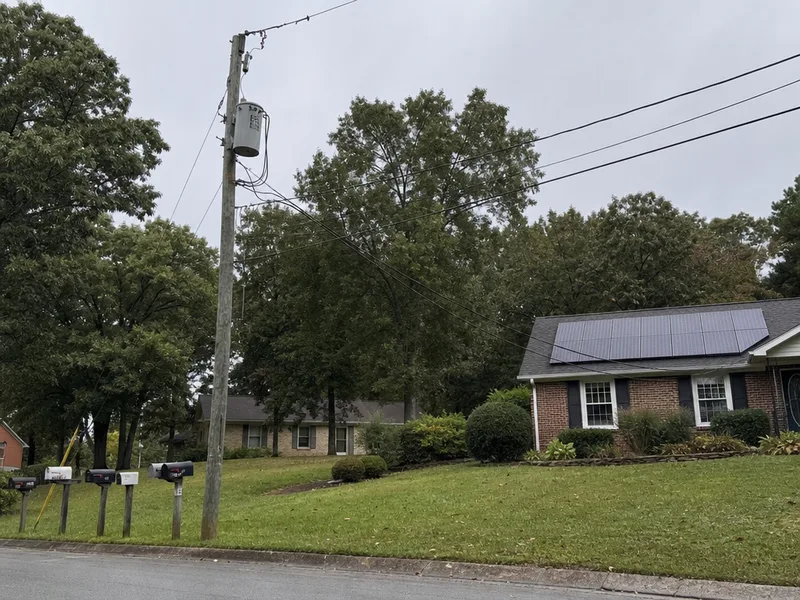
Net metering is the arrangement most solar advice is written around: you export a kilowatt-hour, the meter effectively runs backwards, and you get that kilowatt-hour back later at the price you would have paid for it.
Tennessee does not do that. The DSIRE database of state incentives records that Tennessee does not offer net metering and does not have standardized interconnection rules (DSIRE, checked 2026-08-05).
Both halves of that sentence matter. No net metering means your surplus is sold rather than banked. No standardized interconnection rules means the process is set by your local power company rather than by the state, so two households twenty miles apart follow different paperwork.
Who you are actually contracting with
This is the structural thing worth getting straight, because almost every explanation online skips it.
TVA is the buyer. It is the federal power producer for the region, and the contract to sell your surplus is with TVA.
Your local power company is the administrator. It owns the poles and the meter, it runs the interconnection process, it inspects and connects, and it is the organisation you will actually speak to. There are two of them in this metro: Nashville Electric Service in Davidson County, and Middle Tennessee Electric across most of the suburban ring.
So the answer to "who do I call about TVA net metering" is: not TVA, and not about net metering.
What the arrangement is called, and why the name keeps changing
The programme most Middle Tennessee installs go through is Dispersed Power Production. Middle Tennessee Electric tells members that under it TVA may allow a qualified solar system to sell excess generated power, that members sign a contract with TVA to sell excess solar generation for roughly 2 cents per kilowatt-hour, and that the contract process can take two to three months (MTE, checked 2026-08-05).
That is the one rate figure on this page. A guide to export pricing that refuses to state the price is not much of a guide, but the number is not what this page is for. What that rate means for whether you should buy a battery is worked through on our solar battery installation page, which is where that decision belongs.
You will also see Green Connect and, on older pages, Green Power Providers. The customer-facing naming has changed more than once, which is the single biggest reason the search results for this topic are unreliable: a page written three years ago describing a programme by a name nobody uses now still ranks, still reads plausibly, and still has a number in it.
One rule survives every renaming: read your own power company's current solar page. The local power company administers the agreement, and its published terms are the ones you are held to.
What Nashville Electric Service publishes
NES runs two programmes and they are drawn around array size and surplus rather than around who you are.
| NESolar Savings | NESolar Connect | |
|---|---|---|
| Array size it is drawn for | Smaller than 250 kW | Larger than 200 kW |
| What NES purchases | The excess energy transferred to the grid | 100% of the customer's output |
| Qualifying condition | An average monthly surplus of at least 50 kWh | Set by the programme guidelines |
| What you sign | A Power Purchase Agreement and an Interconnection and Operating Agreement | A Power Purchase Agreement and an Interconnection and Operating Agreement |
| Who it fits | Ordinary residential and small commercial arrays | Commercial-scale generation |
The 50 kWh line in the left column is the one to notice. A residential array sized close to a household's own consumption may never average a monthly surplus that large, in which case there is nothing to sell, and the array's whole value is in the power the house uses directly. That is not a failure. It is just a different project from the one most people think they are buying, and it is worth knowing which one you have before the panels go up.
For a commercial roof the thresholds are the interesting part, because array size decides which programme you are even in. Our commercial solar installation page covers how that interacts with everything else on a project that size.
The timing trap
Two clocks run on a solar project here and they are not the same clock.
The export contract takes two to three months, and Middle Tennessee Electric's own advice is to start the process before the installation is finished rather than after (MTE, checked 2026-08-05). Meanwhile Metro Nashville's photovoltaic permits expire six months after issuance, and work has to begin inside that window (Metro Codes, checked 2026-08-05).
An install that is physically finished is not an install that is exporting. The array can be on the roof, inspected and producing, and still be waiting on a contract before a single kilowatt-hour is bought from you. Nobody enjoys discovering that in month three.
MTE also notes that additional costs, hardware or construction may be required before a system can safely connect to its grid (MTE, checked 2026-08-05). That is worth asking about early, because it is a cost that lands after the quote has been accepted.
What this changes about the decision
Nothing about this makes solar a bad purchase in Middle Tennessee. It makes it a different purchase from the one the national advice describes.
In a net metering state the grid is a battery you are allowed to use for free, so an oversized array is close to harmless. Here, exported power is sold at a price somebody else sets, so the array wants to be sized to what the house actually uses, and the interesting question becomes how to keep more of what you make on your own side of the meter.
That is a storage question, which is why a battery sits nearer the front of the conversation here than it does almost anywhere else.
If you are still working out whether the whole thing pays, our breakdown of what solar panels cost in Nashville has the inputs, and our guide to the Tennessee solar tax credit in 2026 covers what changed at the end of last year.