Commercial solar installation in Nashville, TN
Commercial solar installation in Nashville, TN runs on a different set of rules from the house next door. The roof is usually flat, the plans have to carry a design professional's seal before Metro will look at them, and a business sits under a different tax statute from a household. All three change the scope before anyone talks about panels.
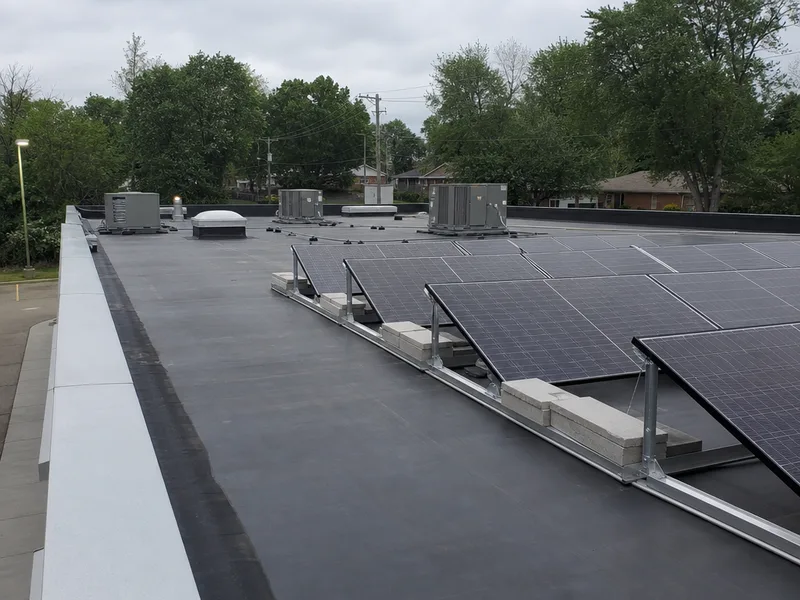
A commercial array is not a bigger house array. The roof is a different shape, the review is a different process, the utility is buying the output under different terms, and the tax position is a different statute. Each of those changes the scope before the equipment is chosen.
What a low-slope roof changes
Most commercial buildings in this market carry a flat or low-slope roof over a steel or concrete deck, and that flips almost every assumption a residential install runs on.
Mounting stops being lag bolts into rafters. It becomes a choice between ballasted racking held down by weight, mechanically attached racking that penetrates the membrane, and clamps on a standing-seam metal roof that grip the seam without piercing it. Each one loads the structure differently, and ballast in particular puts real dead weight on a deck that was designed decades ago for something else.
Orientation opens up too. A pitched roof dictates its own azimuth; a flat roof lets the array be tilted and spaced to suit the building's own demand curve, which for most businesses peaks in the middle of a working day.
And the roof's remaining life becomes a hard question rather than a soft one. A membrane with a few years left under a twenty-five year array is a removal and reinstall already scheduled, and it is cheaper to face that before the array goes on.
What Metro Nashville wants sealed, and why it is the real difference
This is the requirement that separates a commercial job from a residential one in Davidson County, and it is checkable rather than folklore.
For a sloped residential roof, Metro's own checklist observes that panel weight is often less than 3 pounds per square foot, which most residential roof surfaces in good condition can support, and asks for verification of structural capacity and a scaled roof plan. For larger commercial buildings and other structures with flat roofs, it says a licensed architect or engineer must approve the installation plans before submission, and that photovoltaic plans for commercial and office structures must include layout plans and details affixed with the seal of a licensed professional architect or engineer (Metro Codes, checked 2026-08-04).
So the design professional is not optional overhead on a commercial project. The permit will not proceed without a sealed plan, and wind resistance on a ballasted or clamped array is precisely what that seal is attesting to. Metro also runs its solar review as an Electrical Photovoltaic permit with a separate approval alongside Nashville Electric Service, and every photovoltaic permit expires six months after issuance (Metro Codes, checked 2026-08-04).
Outside Davidson County the authority changes. Williamson County, the City of Franklin and the City of Murfreesboro each run their own office, and a plan set prepared for one is not automatically a plan set for another.
Where a business actually stands on the credit
Every other page on this site tells a homeowner the federal credit is gone, because it is. A business is not in that position and it is worth being precise about why.
The residential clean energy credit is not available for any property placed in service after December 31, 2025 (IRS, checked 2026-08-04). That is Section 25D, and it is a homeowner's credit.
Section 48E is a different statute. The IRS describes the clean electricity investment credit as available to taxpayers with a qualified facility and energy storage technology placed in service after December 31, 2024, with a base amount of 6 percent of the qualified investment, increased up to five times, to as much as 30 percent, for facilities meeting prevailing wage and registered apprenticeship requirements (IRS, checked 2026-08-04).
Two things about that are worth saying out loud, because most pages will quote you the larger number and stop.
The base is the smaller one. Reaching the higher figure depends on meeting labour conditions, and whether your project does is a question about how it is built and staffed rather than about the panels.
And the timing rules around this credit have been moving, including in court, so the date a project begins construction and the date it is placed in service both matter. That is your tax adviser's call on your specific project, not an installer's. What we can do is give you a scope with dates in it that they can work from.
What the utility does with the output
At commercial scale the export question changes shape. In Davidson County, NES purchases 100 percent of the customer's output on systems larger than 200 kW under NESolar Connect, while NESolar Savings covers arrays smaller than 250 kW that produce an average monthly surplus of at least 50 kWh (NES, checked 2026-08-04).
Which side of that a project falls on changes the financial model more than most equipment decisions do, so it is worth settling at the feasibility stage.
What we need to scope a commercial project
Send the building address, the roof type and its age, roof or structural drawings if you have them, and twelve months of utility data for the meter. If there is a roof warranty in force, send that too, because who is allowed to touch the membrane is often already decided by it.
What comes back is a scope: mounting approach, the structural review the permit will require, an array size against your own demand curve, and the utility programme the project falls under.
Residential work sits under solar installation in Nashville, TN, and the solar services hub lists everything else. The wider tax position is in our guide to the Tennessee solar tax credit in 2026, and how export is priced here is in TVA net metering in Tennessee.
What people ask before booking this
Is the 30% solar tax credit going away in 2026?
For a home it already went: the IRS states that the residential clean energy credit is not available for any property placed in service after December 31, 2025 (IRS, checked 2026-08-04). A business is on a different statute. Section 48E, the clean electricity investment credit, applies to qualified facilities and energy storage placed in service after December 31, 2024, with a base amount of 6 percent of the qualified investment that increases up to five times, to as much as 30 percent, for facilities meeting prevailing wage and registered apprenticeship requirements (IRS, checked 2026-08-04). Which of those two figures applies to your project is a question for your tax adviser, not for an installer.
Does a commercial solar project need sealed drawings in Nashville?
Yes, and it is the clearest difference between a commercial job and a residential one here. Metro Codes asks that photovoltaic installation plans for commercial and office structures include panel layout plans and details affixed with the seal of a licensed professional architect or engineer, and that for larger commercial buildings and other flat-roofed structures the installation plans are approved by an architect or engineer before submission (Metro Codes, checked 2026-08-04). Budget the design work as its own line rather than discovering it at submission.
How long does a commercial permit take?
Metro publishes a best-efforts target of 30 days to review a completed residential application and notes that commercial sites tend to be larger projects with a longer standard review period, and that all photovoltaic permits expire six months after issuance (Metro Codes, checked 2026-08-04). The utility approval runs separately and on its own clock, so the two are worth starting together rather than in sequence.
What does a business do with power it does not use?
That depends on the utility and on scale. In Davidson County, Nashville Electric Service runs NESolar Connect, under which NES purchases 100 percent of the customer's output on systems larger than 200 kW, and NESolar Savings for arrays smaller than 250 kW producing an average monthly surplus of at least 50 kWh (NES, checked 2026-08-04). Which programme a project lands in changes the financial model, so it is settled early rather than late.
Can solar go on a metal or membrane roof without penetrations?
Often, and it is one of the real advantages of a low-slope commercial roof. Ballasted racking sits on the membrane and is held by weight, and standing-seam metal takes clamps that grip the seam without piercing it. Both trade a penetration problem for a structural one, because ballast is dead load and clamps concentrate uplift, which is exactly why the sealed structural review above exists.
What does commercial solar installation cost in Nashville?
Per watt it is usually below residential, because the array is larger and the work is more repetitive, and the total is far higher for the same reason. What moves it most is the roof: its age, its structure, its remaining service life, and whether the array is ballasted, clamped or penetrating. We scope from the roof drawings and twelve months of utility data, and we will say when the roof should be replaced before an array goes on it rather than after.
Guides that go with this job
Start with the roof, not the panel count
Send the roof type, its age and twelve months of meter data. What comes back names the mounting approach and the structural review the permit will want.