Why people get rid of their solar panels
People are getting rid of their solar panels for about six reasons, and only one of them is that solar does not work. The rest are a roof that needed replacing first, an agreement signed without reading the transfer clause, hardware that failed early, or a system that was never sized for the house it went on.
Published .
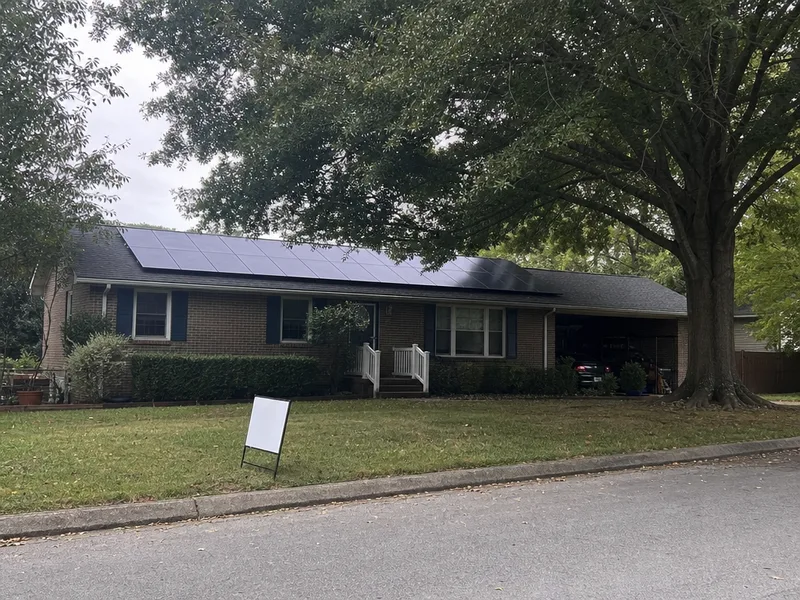
The question is asked often enough that it deserves a straight answer rather than a reassurance. People are getting rid of their solar panels, some of them locally, and the reasons are mostly boring and mostly avoidable.
Almost none of them are "solar does not work in Tennessee".
The roof underneath was older than the array
This is the most common reason panels come off a house, and it is the one nobody budgets for.
Middle Tennessee Electric tells its own members to find out the age and condition of their shingles before buying, and warns that replacing your roof after installing solar panels requires you to remove them, and that this cost is not accounted for most break-even projections (MTE, checked 2026-08-05).
That is a power company, with nothing to sell you, saying the quiet part.
A shingle roof with eight years left and an array with twenty five is a scheduling problem you have already agreed to. The panels come off, the roof is done, the panels go back on, and the bill for that is real. It is a panel removal and reinstall job rather than a removal, and the difference matters: nothing is being thrown away, and the rails and flashing usually go back exactly where they were.
Get the roof's remaining life in writing before you buy an array, not after.
The agreement was a lease and nobody read the transfer clause
This is where most of the genuine regret in this market sits, and it has nothing to do with the hardware.
If you signed a lease or a power purchase agreement, you do not own the equipment on your roof. Somebody else does, you are paying them monthly for fifteen to twenty five years, and when you sell the house the agreement has to go somewhere. Either your buyer accepts and qualifies for it, or you buy it out.
The measured picture is less dramatic than the anecdotes. The US Department of Energy reports that for third-party owned systems, the data shows they add some complexity to the real estate transaction while the overall impacts on sales price, time on market, agreement transfers and customer satisfaction are mostly neutral (US Department of Energy, checked 2026-08-05).
"Mostly neutral" is not "no problem". It means the average outcome is fine and the bad outcome is a transfer negotiation happening two weeks before closing.
That page is worth citing and worth a caveat. Its tax section is years out of date, so take the resale finding from it and take the credit position from the IRS instead, which our guide to the Tennessee solar tax credit in 2026 links directly.
If you are buying, read the transfer clause before you read the price. If you are selling, start that conversation the week you list rather than the week you go under contract.
The system was sized off the wrong numbers
A system that never produced what the salesperson projected is not a broken system. It is usually a system sized off monthly bills instead of actual usage.
Middle Tennessee Electric's advice to members is specific about this: a good contractor will ask for the last twelve months of hourly data, and if a contractor asks only for your monthly bills for the past twelve months, you should move forward with caution (MTE, checked 2026-08-05).
Monthly totals hide the thing that decides everything in this state, which is when you use power. Two houses with identical annual consumption can have completely different solar economics if one is empty from nine to five and the other is not, because Tennessee has no net metering and exported power earns far less than power you use yourself.
So ask for the hourly data. A contractor who does not want it is telling you something.
The inverter failed and nobody diagnosed it
Panels degrade slowly. Inverters fail.
When a system goes quiet, the array is usually fine and one component is not. The failure modes are boring and findable: a tripped or failed inverter, a string that has gone open circuit, a bad connector, a rodent-chewed run, or monitoring that stopped reporting months ago and nobody noticed.
The expensive version of this story is a homeowner who assumed the whole system was finished, got quoted for a whole new system, and paid for one. The cheap version is a solar panel repair call and a meter on the DC terminals.
Find out what failed before you decide the system failed.
The trees grew
Shade that did not exist when the array went up in a Middle Tennessee neighbourhood full of mature hardwoods exists now. Production falls, and it falls faster than people expect, because a partially shaded string can drag down more than the shaded panel.
This one is often fixable with trimming, with a change to how the array is wired, or with module-level electronics. It is very rarely a reason to remove an array.
The company that sold it disappeared
Solar has a high business failure rate, and a workmanship warranty is worth whatever the company behind it is worth. Manufacturer warranties on the modules and the inverter generally survive the installer, which means the part is often covered and the labour is not.
Dig out your paperwork now, while nothing is wrong, and write down the module manufacturer, the inverter manufacturer and the install date. That is what anyone will ask for later.
So what should you actually do
The decision is almost never "keep it or bin it". It is one of three jobs, and picking the wrong one is what makes this expensive.
| What is happening | The job | What it usually is not |
|---|---|---|
| Production dropped or stopped | Diagnose the inverter and the strings first | A whole new system |
| The roof needs replacing | Detach and reset, panels back on the same rails | Removal. Nothing is being disposed of |
| Bills are higher than projected | Check sizing and export assumptions against hourly usage | Faulty equipment |
| Shading has increased | Trimming, rewiring or module-level electronics | A reason to take the array down |
| You want out of a lease or agreement | A contract question, then a removal scope | Something an installer can answer for you |
| The house is being sold | Transfer paperwork, started early | A reason to remove a system you own |
The one that is nobody's fault
The federal credit that used to absorb about a third of the price is gone for anyone buying with cash or a loan: the IRS states that the residential credit is not available for any property placed in service after December 31, 2025 (IRS, checked 2026-08-05).
That does not make anyone's existing array worse. It does mean the arithmetic for a new one is tighter, and it means a system sold on optimistic assumptions has less room to absorb them. If you are being sold one now, our breakdown of what solar panels cost in Nashville has the numbers a quote should be tested against.
And if what you actually have is an array already up there and not earning its keep, give it an hour of diagnosis before you give it a decision.