Solar battery installation in Nashville, TN
Solar battery installation in Nashville, TN answers a question the panels alone cannot. Tennessee has no net metering, so power you export is bought at a rate far below what you pay to buy it back. A battery is what keeps that power on your side of the meter.
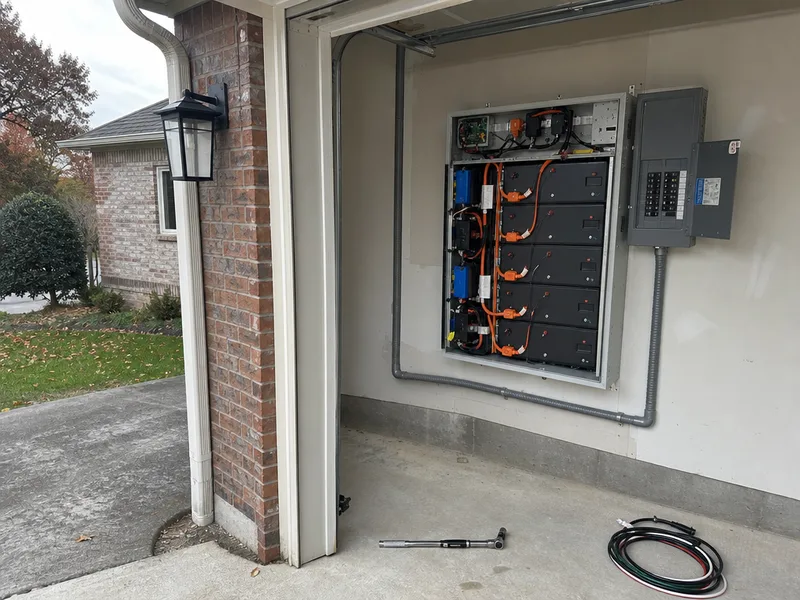
Most solar advice was written for states with net metering, where every kilowatt-hour you export spins the meter backwards and comes back to you at retail. Tennessee is not one of those states, and that single difference is what puts a battery near the front of the conversation here rather than at the end of it.
What Middle Tennessee actually does with the power you do not use
There is no net metering statute in Tennessee. Instead, TVA buys excess generation through its Dispersed Power Production programme, administered by your local power company, and the price is set by avoided cost rather than by what you pay at the meter.
The two power companies that serve this metro handle it differently, and which one you are on is decided by your address.
Middle Tennessee Electric covers the suburban ring. MTE's own solar FAQ tells members that a qualified system can sign a contract with TVA to sell excess solar generation for roughly 2 cents per kilowatt-hour, and that the contract process takes two to three months, so it should be started before the install finishes (MTE, checked 2026-08-04). MTE describes itself as serving more than 750,000 Tennesseans across 11 Middle Tennessee counties, primarily Rutherford, Cannon, Williamson and Wilson, including Murfreesboro, Franklin, Brentwood, Smyrna, La Vergne, Lebanon and Mt. Juliet (MTE, checked 2026-08-04).
Nashville Electric Service covers Davidson County and runs its own programme. Under NESolar Savings, NES purchases the excess energy transferred to the grid from arrays smaller than 250 kW, but only where the array produces an average monthly surplus of at least 50 kWh (NES, checked 2026-08-04). A small array that mostly self-consumes may never clear that bar.
Now the other half of the arithmetic. NES publishes a residential base rate of 9.254 cents per kilowatt-hour, effective October 2024, plus a fuel cost adjustment it lists at 2.610 cents per kilowatt-hour for August (NES, checked 2026-08-14). So a Nashville household buys power back at roughly 12 cents and, in the suburbs, sells its surplus at roughly 2.
That gap is the entire case for storage in this market. A battery does not earn you anything. It stops you selling power at one price and buying it back at six times that price a few hours later.
For how the programme itself works, who administers it and what enrolling involves, read our guide to TVA net metering in Tennessee.
Is a battery worth it in Nashville?
The honest answer is that it depends on a number sitting on your own power bill, and that number is your export volume.
If your array is sized close to your consumption and you are home during the day, you already self-consume most of what you make and there is not much surplus to rescue. Storage then buys you outage cover rather than savings, which is a legitimate reason to want one but a different reason from the one above.
If your array is oversized for the house, or the house is empty between nine and five, you are exporting steadily through the middle of the day at a price set by avoided cost. That is where a battery changes the arithmetic, because every stored kilowatt-hour you use after dark is a kilowatt-hour you do not buy.
We work this out from your bill before quoting hardware. It is a short piece of work and it occasionally ends with us saying a battery is not the right purchase this year.
What whole-home backup really means
Two things get called backup and they cost very different amounts.
A critical loads subpanel is the common one. A set of circuits is moved onto a subpanel the battery can carry: refrigeration, a well pump if you have one, some lighting, internet, a few outlets, sometimes one HVAC zone. The battery is sized for those loads over a realistic outage, not for the house.
Whole-home backup carries the main panel. Every load stays where it is, and the battery system has to handle the worst simultaneous demand the house can produce, which in this climate is usually an air conditioning compressor starting while something else is already running. That drives inverter sizing more than daily consumption does, and it is why a load calculation comes before a price rather than after it.
Neither is better. They answer different questions, and the difference is worth knowing before you compare two quotes that look similar and are not.
What has to line up before a battery goes in
- The existing inverter. A storage-ready hybrid inverter can often take DC coupled storage directly. Anything else, including most microinverter arrays, takes an AC-coupled battery instead. This is usually the first thing we ask about.
- Somewhere to put it. Batteries go next to the electrical panel, not on the roof. Garage walls are the usual answer here. Temperature rating matters more than people expect in a Middle Tennessee garage in August.
- The main panel and the service. Storage adds a source, and older panels sometimes cannot take another breaker in the right position without a reconfiguration.
- The utility. Both NES and MTE run their own interconnection and operating agreement, and adding storage to an already-approved array is a change to what was approved. MTE's own guidance is to start the paperwork early rather than at the end.
- A permit. Metro Nashville handles this as an Electrical Photovoltaic permit, and separate approval runs with Nashville Electric Service (Metro Codes, checked 2026-08-04).
What happens to the credit that used to pay for these
Storage used to be covered by the same federal credit as the panels. That is over for anyone buying with cash or a loan. The IRS states that the residential clean energy credit is not available for any property placed in service after December 31, 2025 (IRS, checked 2026-08-04).
It matters here more than on most pages, because battery quotes were routinely presented net of that credit and some of the material still circulating has not caught up. If a number you have been given assumes a federal credit on storage, ask which one. Our guide to the Tennessee solar tax credit position in 2026 sets out what remains.
How we quote a battery
Send the property address, the existing inverter make and model if there is already an array, and a recent power bill with the export figures on it. What comes back is a scope: capacity, whether it is a subpanel or the whole house, what happens to the existing inverter, and a number.
If the bill says you are barely exporting, we will say the storage case is thin, and why.
The panels themselves are covered on solar installation in Nashville, TN, and the other three jobs are listed on the solar services hub.
What people ask before booking this
Does a solar battery pay for itself in Tennessee?
It depends on how much power you export and what you would otherwise be paid for it. Middle Tennessee Electric tells members that excess generation sells to TVA for roughly 2 cents per kilowatt-hour under the Dispersed Power Production programme (MTE, checked 2026-08-04), while a Nashville Electric Service residential customer buys power back at a base rate of 9.254 cents plus a fuel cost adjustment NES lists at 2.610 cents for August (NES, checked 2026-08-14). Every kilowatt-hour a battery keeps out of that trade is worth the difference. Whether that adds up on your roof is an arithmetic question about your own export volume, and it is the first thing we work out.
What is the difference between backup and whole-home backup?
Backup usually means a subpanel: the battery carries a chosen set of circuits when the grid drops, typically the fridge, the well pump, some lights and a few outlets. Whole-home backup carries the main panel, which means the battery and its inverter have to be sized for everything at once, including the air conditioning compressor starting on a July afternoon. The second one costs considerably more and needs a load calculation before anyone can honestly quote it.
Can I add a battery to solar panels that are already on the roof?
Usually. What decides it is the existing inverter. A string inverter that is not storage ready generally needs either replacing or pairing with an AC-coupled battery, which is the more common retrofit. Microinverters almost always take an AC-coupled battery. If the array is also underperforming, deal with that first, because there is no sense sizing storage around production the array is not currently making. That is a separate job and it is listed on the solar services hub.
Is the 30% solar tax credit going away in 2026?
It already went, and battery storage went with it: the IRS states that the residential clean energy credit is not available for any property placed in service after December 31, 2025 (IRS, checked 2026-08-04), and that credit is the one that covered home battery installations for a homeowner buying with cash or a loan. Anyone quoting you a battery price net of a federal credit today should be asked which credit they mean. We go through what is left in our guide to the Tennessee solar tax credit position in 2026.
Do I need a battery to keep the lights on during an outage?
You need something. A grid-tied array without storage shuts down when the grid goes down, by design, so that it cannot backfeed a line someone is working on. That surprises most people who assume panels equal power during an outage. A battery with an automatic transfer point is what turns the array into something that runs the house, and it is the honest reason many Middle Tennessee households end up buying one after an ice storm rather than before.
What does a home battery cost to install in Nashville?
The wide range is set by capacity and by whether you are backing up a subpanel or the whole house, and the second variable moves the number further than the first. Rather than publish a figure that will not match your panel, your inverter or your loads, we scope it: send the address, the existing inverter model and a recent power bill, and you get a written number back. If the export volume on your bill is small enough that storage will not pay, we will tell you that too.
Guides that go with this job
Work out whether storage pays on your bill
Send a recent power bill with the export figures on it and the make of your existing inverter. The first thing back is the arithmetic, not a quote.