Solar panel removal and reinstall in Nashville, TN
Solar panel removal and reinstall in Nashville, TN is the job that stands between an ageing roof and the array sitting on it. A detach and reset takes the modules and racking off, hands the roofer a clear deck, and puts the system back to the code in force where you live. The order it happens in matters more than most people are told.
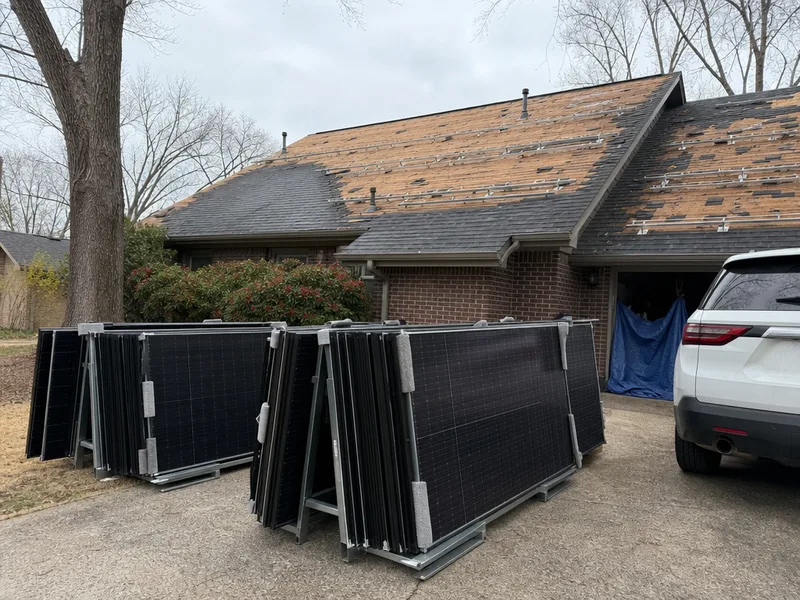
A detach and reset is really a roofing job that happens to involve an array. The modules come off, the roof gets replaced onto a clear deck, and the system goes back up and gets recommissioned. Most of what goes wrong with it goes wrong in the scheduling rather than on the roof.
What is the 33% rule in solar panels?
Nothing else about solar gets asked here this often, and most of what has been written about it is wrong, including a good deal of it on pages that are really selling portable power stations.
It is not a limit on how much of your roof you are allowed to cover.
It is a threshold in the residential code's roof access and pathway provisions, and what it changes is the clear space the code wants along the ridge. The text, in Tennessee's adopted residential code, reads: for arrays occupying not more than 33 percent of the plan view total roof area, a clear setback of not less than 18 inches is required on both sides of a horizontal ridge, and for arrays occupying more than 33 percent, that setback becomes not less than 36 inches (IRC R324.6.2, checked 2026-08-04).
Cross a third of the roof and the strip you have to leave bare at the top doubles. That is the whole rule.
Three things follow from it that are worth more than the headline:
- A sprinklered house gets a different threshold. Where an automatic sprinkler system is installed to NFPA 13D or the plumbing code's residential section, the same setbacks apply at 66 percent instead of 33 (IRC R324.6.2.1, checked 2026-08-04).
- Pathways are the other half, and they bite more often. The code wants not fewer than two pathways at least 36 inches wide running from the lowest roof edge to the ridge on separate roof planes, with at least one of them on the street or driveway side (IRC R324.6.1, checked 2026-08-04). On a cut-up Middle Tennessee roof with several small planes, that is usually what limits the array, not the ridge setback.
- It does not always apply. The section exempts detached non-habitable structures, roofs pitched at two units vertical in twelve horizontal or shallower, and cases where the code official has determined that rooftop operations will not be employed (IRC R324.6, checked 2026-08-04).
The bare strip you can see along the ridge in most residential arrays is this rule made visible. It exists so a fire crew can get to the ridge and cut a ventilation hole, which is why the code official gets the final say on it.
Why the answer depends on which office you are dealing with
This is not a federal standard. It lives in building and fire code, and the edition in force is whichever one your permitting authority adopted.
That difference is real inside this metro. Metro Nashville has adopted the 2024 International Residential Code and the 2023 National Electrical Code (Metro Codes, checked 2026-08-04), while the text quoted above is from Tennessee's statewide 2018 edition. Williamson County, the City of Franklin, the City of Murfreesboro and Metro Nashville are separate authorities having jurisdiction, and a layout approved under one is not automatically approved under another.
For a new install that is background. For a reinstall it is the whole game, because the array is going back under today's code, not the code it was originally approved under. An array laid out in 2016 to an older edition can come back a panel or two shorter. Finding that out before the roofer is booked is worth more than any other single thing on this page.
What Metro Nashville wants to see
Metro treats this as an Electrical Photovoltaic permit. The published checklist asks for verification of structural capacity and a scaled site or roof plan showing the proposed panel layout together with the setbacks and walking paths required by code, and it notes that a separate approval runs with Nashville Electric Service. Permit fees start at $75.00, all photovoltaic permits expire six months after the date of issuance, and Metro aims to review completed residential applications within 30 days (Metro Codes, checked 2026-08-04).
The six month expiry is the one that catches roof projects. A permit pulled early while a roofer is still being scheduled can lapse before the array goes back on.
The sequence, and why it is the part that goes wrong
- Survey before anything is booked. Module count, racking type, inverter type, the roof planes and their pitches, and whether the existing layout still complies. This is what decides whether the array comes back whole.
- Agree the handover in writing. Who lifts, who stores, who flashes the new mounts, who is on the roof on which days, and whose warranty covers the penetrations afterwards.
- Detach. Modules off and labelled by position, wiring managed rather than cut where it can be avoided, racking off, old mounts out, penetrations temporarily sealed. Modules go into covered storage, not onto the lawn.
- The roof gets replaced. A clear deck, which is the entire reason for doing this.
- Reinstall. New mounts set and flashed into the new roof, racking back, modules back to a compliant layout, wiring remade with connectors that match.
- Recommission and verify. Every string tested and the system watched producing before anyone leaves. An array that goes back up and is never checked is how a system spends two years making nothing.
Step 6 is skipped more often than any other, and it is the cheapest one on the list.
When the panels should not go back up
Sometimes the honest answer is that they should not, and it is worth saying before the roof comes off rather than after.
If the array is old, the inverter has already failed once, and trees planted around the house in the 1990s now shade the roof for half the afternoon, the money spent putting an underperforming system back onto a brand new roof is money that would go further on a redesigned array. If it is a leased system, the lease dictates what happens and the leasing company has to be in the conversation before a roofer is booked.
We will tell you which of those you are in. Our guide to why people get rid of solar panels covers the wider version of the same decision, and solar panel cost in Nashville covers what a replacement array is worth.
What we need to quote a detach and reset
Send the property address, the module count, a photograph of the roof taken from the ground showing the whole array, the inverter make and model, and the roofing date if one is already booked.
What comes back separates removal, storage and reinstall as three numbers, flags whether the layout can go back as it is, and says which permit office you fall under. If the roofer has already given you a date, tell us, because the order these two jobs happen in is the thing most worth getting right.
A brand new array on the new roof is a different job, covered under solar installation in Nashville, TN, and the solar services hub lists the rest.
What people ask before booking this
Can a roof be replaced without taking the solar panels off?
Not properly. The mounts are lagged through the shingles into the rafters and flashed, so the roofer cannot strip the deck underneath them, and roofing around an array leaves the oldest, most penetrated part of the roof in place under the newest part. Some crews will do it. What you get is a new roof with the original penetrations and the original flashing still in it, which is the section most likely to leak.
Do the panels go back in the same place?
Usually, and not always. The array goes back to the code in force at the time of the reinstall rather than the code that applied when it first went up, so if the layout was signed off under an older edition and the setbacks or pathways have changed, the array comes back slightly smaller or slightly moved. That is worth knowing before the roof comes off, not after, because it changes the production you get back.
Who is responsible if the roof leaks afterwards?
Split responsibility is the thing to avoid here. When a roofer and a solar crew each own half the penetrations, a leak becomes an argument rather than a repair. The way to prevent it is to agree in writing before anyone starts who is flashing the new mounts and whose warranty covers them, and to have the mounts set into the new roof by whoever is going to stand behind them.
Does the array need a permit to go back up?
In Davidson County the reinstall is handled as an Electrical Photovoltaic permit through Metro Codes, with separate approval running with Nashville Electric Service, and a permit expires six months after issuance if the work has not begun (Metro Codes, checked 2026-08-04). Outside Davidson County the office changes and so can the answer, which is the point of the section on jurisdictions below.
What happens to the equipment warranty when panels come off?
Module and inverter warranties are manufacturer warranties on the hardware and generally survive a removal, as long as nothing is damaged in handling. The workmanship warranty on the original install is the one at risk, because it covers the way the system was fitted and the mounts are about to be refitted by someone else. Read what you have before the job starts, and keep the original paperwork.
What does solar panel removal and reinstall cost in Nashville?
It is priced per module, plus the racking, plus any parts that do not survive the trip, and the count is what moves it. Two things change the number more than anything else: whether the same racking can be reused, and whether the array comes back in the same layout or a compliant new one. Send the module count and a photo of the roof and you get a written number that separates the removal, the storage and the reinstall, so you can see what your roofer is actually scheduling around.
Guides that go with this job
Get the array priced before the roofer is booked
Send the module count and a ground level photo of the roof. You get removal, storage and reinstall as three separate numbers, plus whether the layout can go back as it is.